The history of Israel is filled with dramatic and complex events, and the Altalena affair stands out as a particularly significant episode. In June 1948, a ship named the Altalena arrived at Israel’s coast carrying weapons and fighters for the Irgun, a Zionist paramilitary organization. Prime Minister David Ben-Gurion ordered the ship destroyed, a controversial decision that symbolized the internal tensions shaping the nascent Israeli state and tested the very foundations of the new nation.
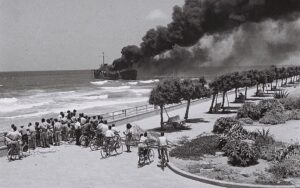
The Altalena was purchased by the Irgun in France and named after the pen name of Zeev Jabotinsky, one of the founders of the Revisionist Zionist movement. The ship was loaded with over 900 fighters and a large cache of weapons intended to bolster the Irgun’s forces during Israel’s War of Independence.
When Israel declared independence on May 14, 1948, Ben-Gurion immediately moved to unify all Jewish armed forces into the Haganah, which would become the Israel Defense Forces (IDF). However, the Irgun, led by Menachem Begin, wanted to retain autonomy and use the weapons from the Altalena for its own units. This fundamental disagreement over military authority would soon spark a crisis.
The Altalena set sail from France in June 1948, and upon approaching the Israeli coast, negotiations between the Irgun and the government quickly broke down. Begin wanted to distribute the weapons to Irgun units in Jerusalem and other areas, while Ben-Gurion demanded that all arms be handed over to the newly formed IDF.
On June 20, 1948, the Altalena reached the coast near Kfar Vitkin. Begin and the Irgun attempted to unload the ship’s cargo, but the IDF, following Ben-Gurion’s orders, demanded the surrender of the weapons. When the Irgun refused, a violent confrontation ensued, resulting in casualties on both sides.
The situation escalated when the Altalena attempted to dock in Tel Aviv. Ben-Gurion, emphasizing the need for a single unified military force and fearing a potential civil war, ordered the IDF to stop the ship. On June 22, after continued resistance from the Irgun, Ben-Gurion gave the controversial order to shell the Altalena. The resulting explosion and fire led to the deaths of 16 Irgun members and three IDF soldiers, and the ship sank off the coast of Tel Aviv.
The destruction of the Altalena was a turning point in Israeli history. It established the authority of the new government and underscored the importance of a unified military force. Despite the initial outrage and division it caused, the event eventually reinforced the primacy of the state’s authority over independent armed factions.
Menachem Begin, despite his deep anger and the loss of his comrades, urged his followers to avoid retaliatory violence. This crucial decision helped prevent a potential civil war and played a vital role in stabilizing the new state and fostering national unity. The Altalena affair remains a deeply emotional episode in Israeli history, highlighting the complex dynamics and difficult choices faced by leaders of the fledgling state. It stands as a testament to the challenges of nation-building and the sacrifices made to ensure the survival and unity of Israel.
For more detailed accounts, consider reading works such as “The Birth of Israel: Myths and Realities” by Simha Flapan and “Ben-Gurion: A Political Life” by Shimon Peres. These sources provide deeper insights into the historical context and significance of the Altalena affair.
What was the Altalena and why did it matter? The Altalena was a ship carrying weapons and fighters for the Irgun in 1948. It mattered because Ben-Gurion’s decision to destroy it established the new Israeli government’s authority over independent armed groups, preventing a potential civil war and cementing the IDF as the unified military force.
Why did Ben-Gurion order the Altalena destroyed? Ben-Gurion feared the Irgun’s autonomy could fragment the new state during its war for survival. He insisted all weapons go to the IDF to create one unified military. When the Irgun refused to surrender the ship’s cargo, he ordered it shelled to enforce this principle.
How many people died in the Altalena incident? Nineteen people died: 16 Irgun members and 3 IDF soldiers. The confrontation occurred in two phases—first at Kfar Vitkin on June 20, then escalated in Tel Aviv on June 22, 1948, when the ship was shelled and sank.
Did Menachem Begin seek revenge after the Altalena? No. Despite his anger and the loss of his comrades, Begin urged his followers to avoid retaliatory violence. This crucial decision prevented a civil war and helped stabilize the fledgling state, earning him respect even from opponents.