As of January 2025, Israel’s real estate market exhibits a dynamic landscape marked by notable growth and regional variations, with Tel Aviv standing out as a particularly active hub.
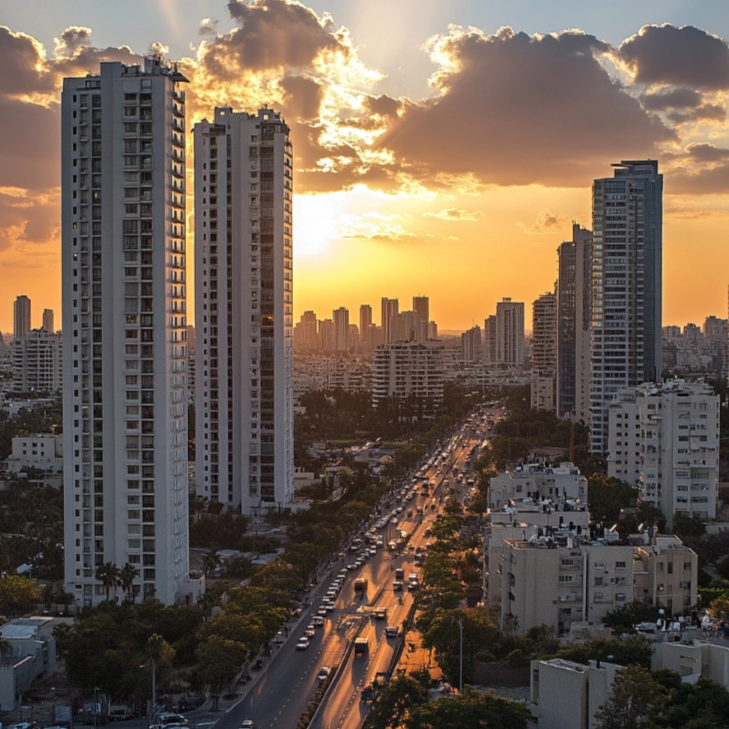
In the first five months of 2024, Israel experienced a significant resurgence in its housing market. New dwelling sales surged by 58.6% year-over-year, totaling 18,402 units, while existing dwelling sales rose 15.1% to reach 20,126 units during the same period. (Source: Times of Israel)
Data from the Central Bureau of Statistics reveals a 0.5% rise in housing prices during September and October 2024 compared to the preceding two months. On an annual scale, this represents a 6.7% increase from the same period in the previous year, demonstrating sustained upward momentum in the market.
Tel Aviv, Israel’s economic and cultural epicenter, has demonstrated remarkable activity in its real estate sector. The city witnessed a 71.5% year-over-year increase in new housing transactions, amounting to 3,270 units in the first five months of 2024. (Global Property Guide) During the first quarter of 2024, property sales surged by approximately 30% compared to the same period in 2023, marking the highest number of transactions in recent years. (Sands Of Wealth)
Despite a record supply of new apartments, Tel Aviv recorded the highest monthly increase in housing prices at 1.2% in late 2024. (Jerusalem Post)
The broader economic context has played a pivotal role in shaping the real estate market. Israel’s economy grew by an annualized 3.8% in Q3 2024, surpassing expectations, driven by an 8.6% increase in consumer spending and a 21.8% rise in investment in fixed assets, particularly residential buildings. (Reuters)
The inflation rate held steady at 3.5% in September 2024, remaining above the government’s target of 1-3%. Officials attribute this to war-related supply disruptions, which may continue to influence market dynamics in the near term.
Looking ahead, the real estate market is projected to continue its growth trajectory. The market is expected to reach a value of US$2.84 trillion in 2025, with residential real estate holding the dominant position at US$2.32 trillion. An annual growth rate of 5.14% is anticipated from 2025 to 2029, resulting in a market volume of US$3.47 trillion by 2029. (Statista)
In summary, Israel’s real estate market, particularly in Tel Aviv, is experiencing significant growth fueled by increased transactions and rising property values. This trend is underpinned by robust economic performance and sustained demand, positioning the market for continued expansion in the coming years.
Yes. Israel’s real estate market is experiencing significant growth, with new dwelling sales surging 58.6% year-over-year in early 2024 and Tel Aviv seeing a 71.5% increase in new housing transactions. The market is projected to reach US$3.47 trillion by 2029.
As Israel’s economic and cultural hub, Tel Aviv attracts strong demand for both residential and commercial properties. The city recorded a 1.2% monthly increase in housing prices in late 2024, the highest in the country, despite new apartment supply.
Israel’s economy grew 3.8% annualized in Q3 2024, driven by 8.6% consumer spending increase and 21.8% rise in residential investment. However, inflation remains at 3.5%, slightly above the government’s 1-3% target due to supply disruptions.
Israel’s real estate market is expected to reach US$2.84 trillion in 2025, with residential real estate representing US$2.32 trillion of that value, growing at approximately 5.14% annually through 2029.